
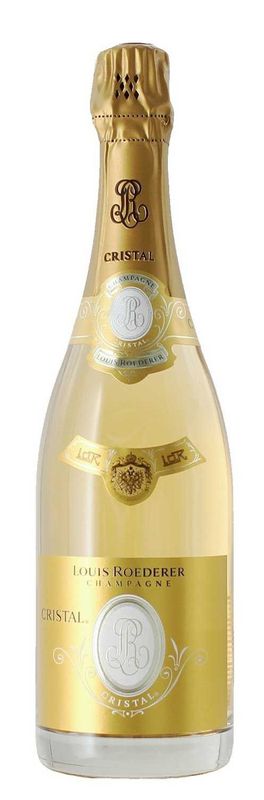
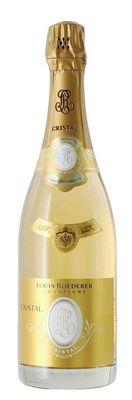
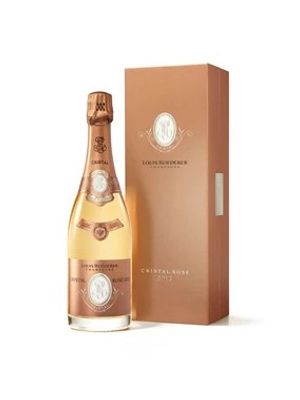
Louis Roederer Cristal 2016 [3-pac]
Antal flaskor / låda: –
'Cristal är i dag den mest eftersökta prestigechampagnen och har kanske det mest aptitretande utseendet av alla viner världen över. Cristal Rosé är inte bara den dyraste roséchampagnen. Den är också den klart bästa. För mig är huset ett av de tre främsta i hela Champagne. Varje årgång är lysande så köp alla Roederers årgångsviner ni kommer över!' - Richard Juhlin
Läs mer
| Sötma | 1 |
| Fyllighet | 6 |
| Syra | 10 |
| Typ | Champagne från Reims Champagne |
| Fraktkostnad | 169:- |
| Druvor | Chardonnay, Pinot Noir |
| Fruktsyra | 10 |
| Distrikt | Montagne de Reims |
| Årgång | 2016 |
| Producent | Champagne från Louis Roederer |
| Artikelnr | Cristal 111 |
| Avnjutes mellan | 2027 - 2056 |
| Drickfönster | 2027–2056 |
Relaterade produkter
Beskrivning av Louis Roederer Cristal 2016 [3-pac]
'Cristal är i dag den mest eftersökta prestigechampagnen och har kanske det mest aptitretande utseendet av alla viner världen över. Cristal Rosé är inte bara den dyraste roséchampagnen. Den är också den klart bästa. För mig är huset ett av de tre främsta i hela Champagne. Varje årgång är lysande så köp alla Roederers årgångsviner ni kommer över!' - Richard Juhlin
Druvor
58 Pinot Noir, 42 Chardonnay
Tasting note
The finest rendition since 2013, the 2016 Cristal has turned out beautifully. A vintage that Lecaillon describes as “difficult in the vineyards but beautiful in the cellar,” it had suffered slightly in reputation due to the gloomy mood during the challenging growing season, but the results are indeed impressive. The fifth edition produced entirely from organically farmed and certified fruit, and heavily based on Pinot Noir, the 2016 represents the contemporary quality of Cristal, combining the concentration of 2002 with the precision and cut of 2013. Disgorged in July 2024 with a dosage of seven grams per liter, it opens in the glass to reveal a bouquet of lemon zest, white flowers and peeled almond, framed by youthful reduction. On the palate, it is bright and electric, with a pure core of fruit, pinpoint mousse and a textural attack, concluding with a long, saline finish. Drink it alongside the 2015, and it will illuminate its clarity and integration.
-
Robert Parker Wine Advocat
This report covers the recent and forthcoming releases from Louis Roederer, tasted with Jean-Baptiste Lecaillon in Reims earlier this year. Among these is the new Collection 245—a refined introduction to the house's evolving style, it's a reimagined cuvée that has replaced their Brut Premier. The focus of this wine has now shifted to highlighting the base vintage rather than producing a consistently uniform style year after year. Other featured wines include the latest Blanc de Blancs, Brut Vintage and Brut Vintage Rosé and various vintages of Cristal and Cristal Rosé. Among these is an embarrassment of riches from which to select, such as the precise and incisive 2016 Cristal, as well as the extraordinarily pure 2013 Cristal and 2013 Cristal Rosé. Both 2013 releases are now available in magnums (spoiler: they are even more complete than the standard-size bottles, combining intensity with a graceful texture). The Coteaux Champenois continues its upward trajectory, and the 2022 vintage, shaped by a warm and dry growing season, is well worth seeking out as well.
It is difficult to pinpoint what is most impressive about Cristal—the fact that these Champagnes are crafted from meticulously farmed vineyards or that they are produced in volumes that proves high quality is not exclusive to small growers but can also be achieved on a larger scale. Cristal and Cristal Rosé, based on organically certified farming since 2012, continue to deliver outstanding performances, maintaining their reputation as two of the finest cuvées in the Grande Marque category.
While I generally favor a lower dosage—since it can occasionally assert itself on the finish, particularly as the wine warms—Lecaillon emphasizes that this very dosage is what will sustain these Champagnes far into the future. Notably, the dosage has been reduced in recent years, and contemporary vintages exhibit greater clarity than ever before.
Under the stewardship of Jean-Baptiste Lecaillon, who oversees both winemaking and viticulture, Roederer has embarked on what could be described as a viticultural renaissance, which for Roederer means pursuing massal selection, harvesting fully ripened fruit, planting fruit trees and encouraging biodiversity in and around their vineyards, all with the goal of leaving the land in better condition than when they found it. Of Roederer’s 242 hectares, which supply most of their needs, an impressive 50% is now certified organic and is also managed following biodynamic practices. The only cuvée that includes some purchased fruit is the NV Collection. It's worth noting, however, that Cristal Rosé is sourced from only four lieux-dits, while Cristal is informed by approximately 45 plots. The story of each wine is told in greater detail in the accompanying tasting notes.
-
Domänen grundades 1760 under namnet Dubois Père & Fils och fick sitt nuvarande namn 1833. Louis Roederer var en hårt arbetande man som lyckades sälja sin Champagne på flera viktiga exportmarknader. Roederers verkliga ess var den ryska marknaden. Tsar Alexander II ville ha en mer imponerande etikett för att visa sina gäster, och 1876 beställde han de första transparenta Cristal-flaskorna, som vid den tiden faktiskt var gjorda av äkta kristall. Vinet var fantastiskt sött och...
This report covers the recent and forthcoming releases from Louis Roederer, tasted with Jean-Baptiste Lecaillon in Reims earlier this year. Among these is the new Collection 245—a refined introduction to the house's evolving style, it's a reimagined cuvée that has replaced their Brut Premier. The focus of this wine has now shifted to highlighting the base vintage rather than producing a consistently uniform style year after year. Other featured wines include the latest Blanc de Blancs, Brut Vintage and Brut Vintage Rosé and various vintages of Cristal and Cristal Rosé. Among these is an embarrassment of riches from which to select, such as the precise and incisive 2016 Cristal, as well as the extraordinarily pure 2013 Cristal and 2013 Cristal Rosé. Both 2013 releases are now available in magnums (spoiler: they are even more complete than the standard-size bottles, combining intensity with a graceful texture). The Coteaux Champenois continues its upward trajectory, and the 2022 vintage, shaped by a warm and dry growing season, is well worth seeking out as well.
It is difficult to pinpoint what is most impressive about Cristal—the fact that these Champagnes are crafted from meticulously farmed vineyards or that they are produced in volumes that proves high quality is not exclusive to small growers but can also be achieved on a larger scale. Cristal and Cristal Rosé, based on organically certified farming since 2012, continue to deliver outstanding performances, maintaining their reputation as two of the finest cuvées in the Grande Marque category.
While I generally favor a lower dosage—since it can occasionally assert itself on the finish, particularly as the wine warms—Lecaillon emphasizes that this very dosage is what will sustain these Champagnes far into the future. Notably, the dosage has been reduced in recent years, and contemporary vintages exhibit greater clarity than ever before.
Under the stewardship of Jean-Baptiste Lecaillon, who oversees both winemaking and viticulture, Roederer has embarked on what could be described as a viticultural renaissance, which for Roederer means pursuing massal selection, harvesting fully ripened fruit, planting fruit trees and encouraging biodiversity in and around their vineyards, all with the goal of leaving the land in better condition than when they found it. Of Roederer’s 242 hectares, which supply most of their needs, an impressive 50% is now certified organic and is also managed following biodynamic practices. The only cuvée that includes some purchased fruit is the NV Collection. It's worth noting, however, that Cristal Rosé is sourced from only four lieux-dits, while Cristal is informed by approximately 45 plots. The story of each wine is told in greater detail in the accompanying tasting notes.
-